

AI-Powered Solar Cleaning System by Solabot Technologies Pvt. Ltd.
August 1, 2026
Automatic Solar Panel Cleaning System by Solabot Technologies Pvt.Ltd
August 20, 2026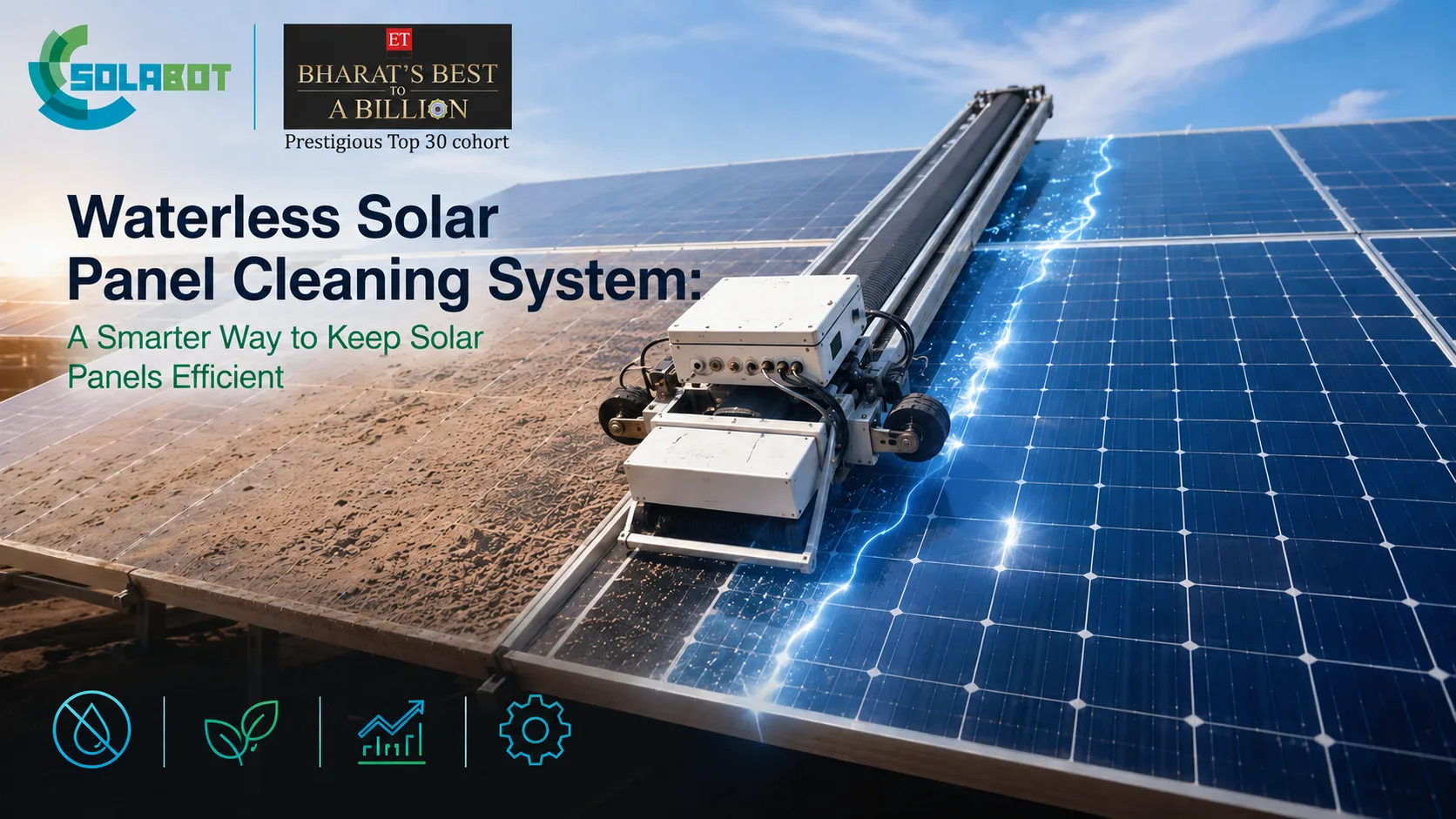
How Waterless Solar Panel Cleaning Helps Maintain Solar Plant Performance
Solar power is clean, sustainable, and increasingly cost-effective. But there’s one simple problem that every solar plant eventually has to deal with — dust.
Dust, sand, pollen, bird droppings and other surface particles gradually settle on solar panels. And while a little dust may not look like much, over time it can reduce the amount of sunlight reaching the photovoltaic cells, affecting overall power generation.
Traditionally, cleaning solar panels has meant using water, labour and sometimes heavy equipment. For a small rooftop installation, that may be manageable. But when you’re dealing with hundreds or thousands of panels across a large solar plant, things become quite different.
This is where a waterless solar panel cleaning system can make a real difference.
Modern dry cleaning technology uses controlled mechanical cleaning to remove dust and debris from the panel surface, not large amounts of water. For solar plants looking for a more efficient, automated and sustainable maintenance approach, it is becoming a very practical solution.
And this is exactly the area where Solabot Technologies Pvt. Ltd. brings its experience.
Why Solar Panel Cleaning Matters More Than It Seems
Solar panels are designed to sit outdoors for years, exposed to whatever the environment brings. In dusty regions, the accumulation can happen surprisingly quickly.
Dust that accumulates on a panel creates a layer between the sunlight and the photovoltaic surface. And as that layer thickens, it can increasingly block the generation of solar energy.
The effect, of course, depends on location, weather, angle of the panels, dust composition and several other factors. One thing, however, is consistent: keeping solar panels clean is important for maintaining the performance of a solar power plant.
“The problem is they need to be cleaned regularly without adding to the operational headaches.”
Cleaning is done manually, requiring workers to move around the plant, handling equipment and repeating the process on large panel arrays. Water based cleaning can also create issues of availability, transport, drainage and repeated consumption.
So, the question becomes quite simple — can solar panels be cleaned effectively without depending on water?
Yes. That’s where a waterless solar panel cleaning system comes in.
What Is a Waterless Solar Panel Cleaning System?
A waterless solar panel cleaning system is developed to clean accumulated dust and loose contaminants on solar panels without the use of conventional water-based washing.
In an automated system, robotic cleaning devices travel on the surface of the solar panel or along pre-set lines of the panels, while special cleaning mechanisms remove dust and debris.
The idea sounds simple, but the engineering behind it needs to be precise.
Solar panels have delicate surfaces. The cleaning system must therefore maintain controlled contact, move consistently and avoid unnecessary pressure or abrasion. At the same time, it needs to cover the required panel area efficiently.
This combination of automation and dry cleaning is particularly useful for large-scale solar installations where cleaning is not a one-time activity. It is ongoing maintenance.
Why Go Waterless?
Water is valuable. That becomes even more obvious when a solar plant is located in a dry or water-stressed region.
Traditional solar panel cleaning can involve water consumption at every cleaning cycle. Multiply that by a large solar farm and repeated cleaning schedules, and the requirement can become significant.
A waterless solar panel cleaning system reduces this dependence.
There is also less need to arrange water transportation, storage and distribution around the plant. That can simplify maintenance operations and reduce the logistical work involved in keeping panels clean.
And then there is the environmental side.
Solar energy is already built around the idea of cleaner energy. Using a dry cleaning method helps support that goal by reducing the need for water during routine panel maintenance.
It’s a small change in the cleaning process, perhaps, but across a large solar installation, small changes can add up.
From Manual Cleaning to Robotic Cleaning
For years, manual cleaning was the obvious choice because it was straightforward. Workers, brushes, water and cleaning equipment — that was the process.
But solar plants have grown considerably in size.
Cleaning a few panels is one thing. Cleaning a large solar power plant repeatedly is another.
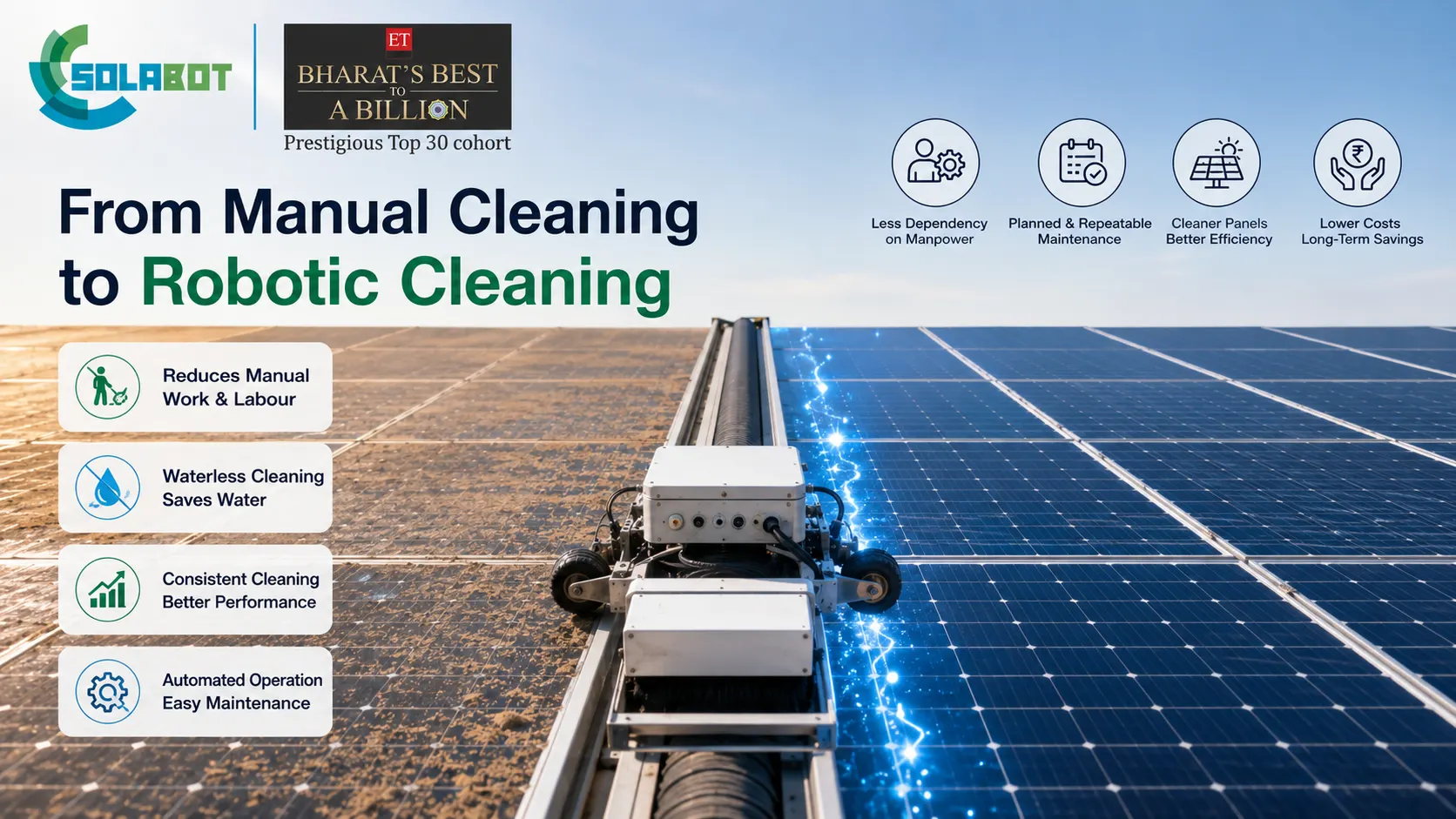
A robotic solar panel cleaning system helps shift this process from labour-intensive maintenance toward automated operation. The robotic unit can be designed to move systematically across the panel rows and perform dry cleaning according to the requirements of the installation.
This can help reduce dependency on manual cleaning teams while making the cleaning process more consistent.
There’s also a practical advantage: robotic systems can be integrated into planned maintenance routines rather than relying entirely on workers moving from one section to another.
For plant operators, that means cleaning becomes more organised, repeatable and easier to manage.
The Solabot Approach to Solar Panel Cleaning
With 10 years of experience, Solabot Technologies Pvt. Ltd. specializes in developing premium automatic dry-cleaning robotic solar panel cleaning solutions for solar panels installed in solar power plants.
Advanced cleaning technology helps the company to reduce manual effort and operational costs.
What makes this particularly relevant is the range of project environments involved. Solar plants are not all the same. Panel layouts, site conditions, installation stages and operational requirements can differ considerably.
Solabot works with both commissioned and under-construction solar projects, providing cleaning solutions according to the requirements of the installation.
This project experience matters because robotic cleaning isn’t simply about putting a machine on a solar panel and letting it move.
The system has to work with the design of the solar plant, the arrangement of the panels and the operational conditions. A good cleaning solution has to be practical in the real world — not just impressive on paper.
How Does Dry Robotic Cleaning Help Solar Plants?
The biggest advantage of a waterless solar panel cleaning system is, naturally, reduced water dependency. But that is only part of the story.
Automation can also help reduce the amount of manual labour required for routine cleaning. For large solar plants, this can be particularly valuable because labour requirements increase with the size of the installation.
There can also be operational savings over time.
Instead of repeatedly arranging water, manpower and conventional cleaning equipment, plant operators can use an automated system as part of their regular maintenance strategy.
Another important factor is consistency.
A robotic cleaning system follows a defined movement and cleaning process. That can help create a more systematic cleaning routine across large panel arrays.
And perhaps most importantly of all, it facilitates scheduling regular cleanings.
Instead of waiting until panels are visibly dirty operators can plan cleaning based on site conditions dust build up and plant requirements.
Waterless Cleaning for Large Solar Farms
The benefits become even more noticeable when we look at utility-scale solar projects.
Large solar farms can contain enormous numbers of photovoltaic modules spread across extensive areas. Sending workers across these installations for frequent cleaning can be time-consuming and difficult to manage.
A waterless solar panel cleaning system for solar farms provides a way to automate a large part of this routine maintenance.
For areas with high dust levels, desert-like conditions or limited access to water, dry robotic cleaning can be particularly attractive.
It can also complement the broader objective of reducing the operational footprint of a solar plant.
After all, the purpose of solar energy is not only to generate electricity. The entire operation should ideally be efficient, resource-conscious and sustainable.
Is Waterless Solar Panel Cleaning Suitable for Every Plant?
Not necessarily. And that’s a big point.
The right cleaning method depends on the environmental conditions of the site, the panel configuration, the characteristics of the dust, the installation design and the operational requirements.
Dry robotic cleaning is very good at removing loose dust and regular surface build-ups. However, certain contaminants may require additional cleaning methods depending on the site.
That is why selecting a solar panel cleaning system should not be based on a one-size-fits-all approach.
A proper assessment of the solar plant is important before deciding how automation should be implemented.
Solabot’s experience across commissioned and under-construction projects allows the cleaning solution to be considered in the context of the actual solar installation rather than as a generic piece of equipment.
A More Practical Future for Solar Panel Maintenance
Solar plants are built to operate for decades. During that time, maintenance is not an occasional requirement — it is part of the plant’s everyday life.
As the solar industry expands, the way panels are maintained will need to evolve too.
The waterless solar panel cleaning system represents one of those changes. It combines automation, dry cleaning and robotic movement to address a very basic but important requirement: keeping solar panels cleaner without depending heavily on water and manual labour.
For solar plant owners, EPC companies and operators, the potential benefits are clear — lower water dependency, reduced manual effort, streamlined maintenance and a more sustainable cleaning process.
And sometimes, the smartest technology isn’t the one that completely changes what we do. It is the one that makes a familiar task much easier.
Choosing the Right Solar Panel Cleaning System
A solar panel cleaning solution should ultimately be judged by how well it performs in the actual operating environment.
The size of the solar plant, panel layout, local dust conditions, cleaning frequency and maintenance strategy all matter. A system that works well for one installation may need to be configured differently for another.
This is why experience matters.
Solabot Technologies Pvt. Ltd. is a 10-year-old company working on automatic dry-cleaning robotic solutions for solar panels. The company is helping solar projects reduce the need for manual cleaning and operational challenges.
A waterless solar panel cleaning system could be a clever way for solar plants to perform maintenance more efficiently, particularly where there are persistent concerns about water availability, the need for labor and the regular accumulation of dust.
Solar panels already do the heavy lifting of turning sunlight into clean energy. Keeping clean shouldn’t be yet another complicated process.
With robotic dry cleaning, it doesn’t have to be.